Civil
Rights Movement
Hear a clip from “I Have a Dream”
Martin led the bus boycott in Montgomery, Alabama. For over a year
the black people of Montgomery did not ride the buses. In the end the Supreme
Court declared that the buses were to be desegregated. They celebrated their
first major victory. The boycott ended on December 21, 1956. He led “sit ins”
were they would sit at white only lunch counters. When the sit-ins began to
succeed he organized “freedom riders” to ride buses into states that still had
segregated buses. In some places the buses were burned and the freedom riders
beaten. Eventually all buses were desegregated. Martin’s non-violent tactics
had succeeded again.
Many people did not wish for change, even some black people. While
he was signing copies of his book, Stride Towards Freedom: the Montgomery
Story, a black woman came in and asked if he was Martin Luther King Jr. When he
told her that he was she stabbed him in the chest with a penknife. Luckily he
survived. In Birmingham, Alabama protesters were beaten and sprayed with
powerful fire hoses, but in the end they won again and Birmingham removed all
of its white only signs.
On June 11, 1963 President John F. Kennedy made a speech on
television calling for equality, shortly after he submitted the Civil Rights
Bill to congress. The bill outlawed every kind of segregation. On August 28,
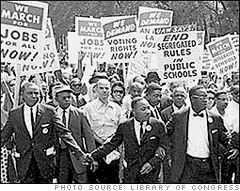
1963 250,000 people gathered at the Washington monument and Martin gave his I
have a dream speech. In October 1964 he received the Nobel Peace Prize. At 35
he was the youngest person to receive this honor. The award came with $54,000
in cash. He donated it all to civil rights causes.
In 1966 he initiated Operation Breadbasket in Chicago. It was an
outstanding success, in less than one year it was responsible for more than
2,200 jobs for African Americans. Marin criticized the Vietnam War, saying that
the money going into the war would be spent fighting poverty here at home. To
let his feelings be known he decided that another huge gathering in Washington
would be needed. He began planning what would be called “the poor peoples
march” in the summer of 1967. The march was to take place in 1968.
Martin Luther King,
Jr. (home)